
Your Future Self Already Exists
There is a version of you that already has everything you are chasing. The only thing standing between you and that person is not time, money, or luck. It is identity. And neuroscience proves exactly how the switch works.
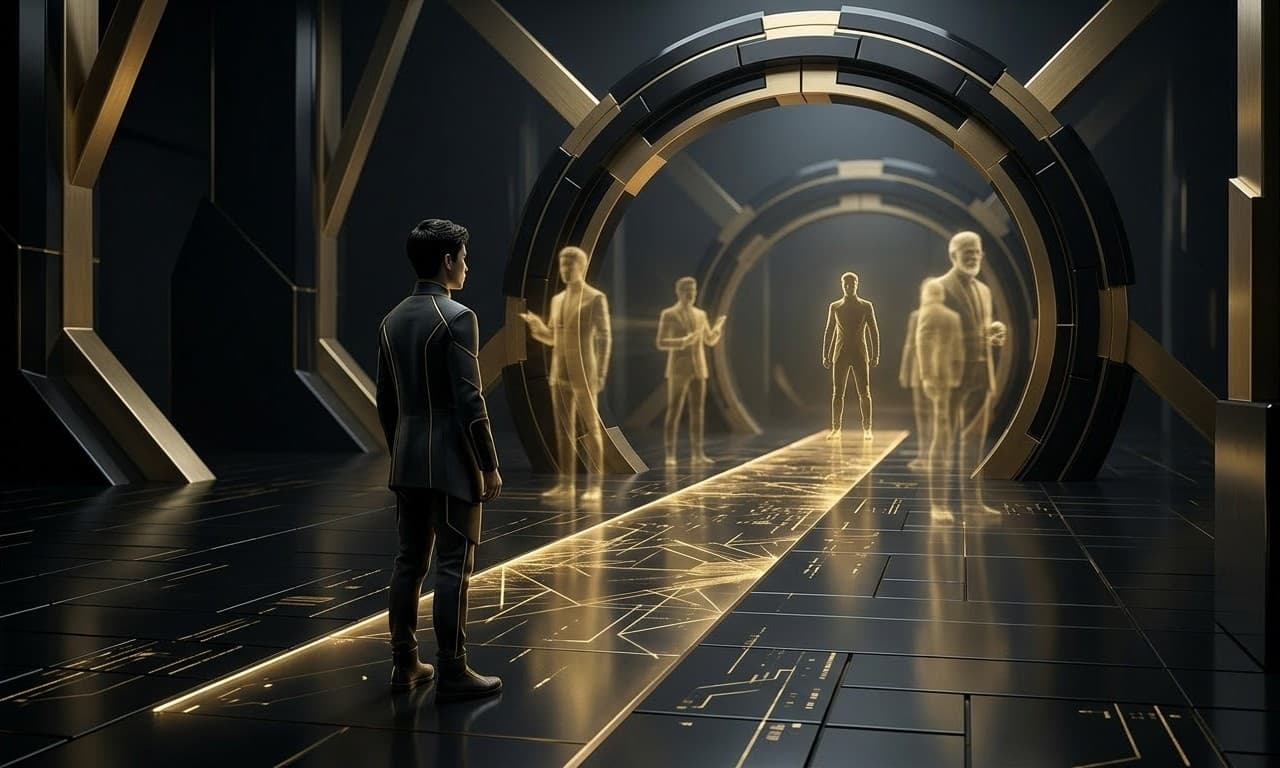
There is a version of you that already has everything you are chasing.
Not as a fantasy. Not as a goal on a vision board. As something so close to you that the only thing standing between you and that person is not time, money, or luck.
It is identity.
And the science behind why that is true will change how you see every decision you make from today forward.
The Science Most People Will Never Hear
You were taught that success is linear. Step one, step two, step three. Work harder. Wait longer. Earn your turn. So you keep stacking steps, burning years, and wondering why the life you want still feels just as far away as when you started.
Here is the problem. This is not a strategy issue. This is an identity issue.
In 1957, physicist Hugh Everett proposed something called the Many-Worlds Interpretation of quantum mechanics. The idea: every possible outcome of every decision exists simultaneously as its own reality. Not as a metaphor. As a real, branching universe.
Now, I am not telling you that you can quantum-leap into a parallel dimension by thinking hard enough. That is not how physics works.
But here is why this matters as a lens. If infinite versions of your life are theoretically possible, then the version you are currently living is not the only option. It is the one your current identity keeps selecting.
How Your Brain Selects Your Reality
Neuroscience confirms exactly how this selection happens.
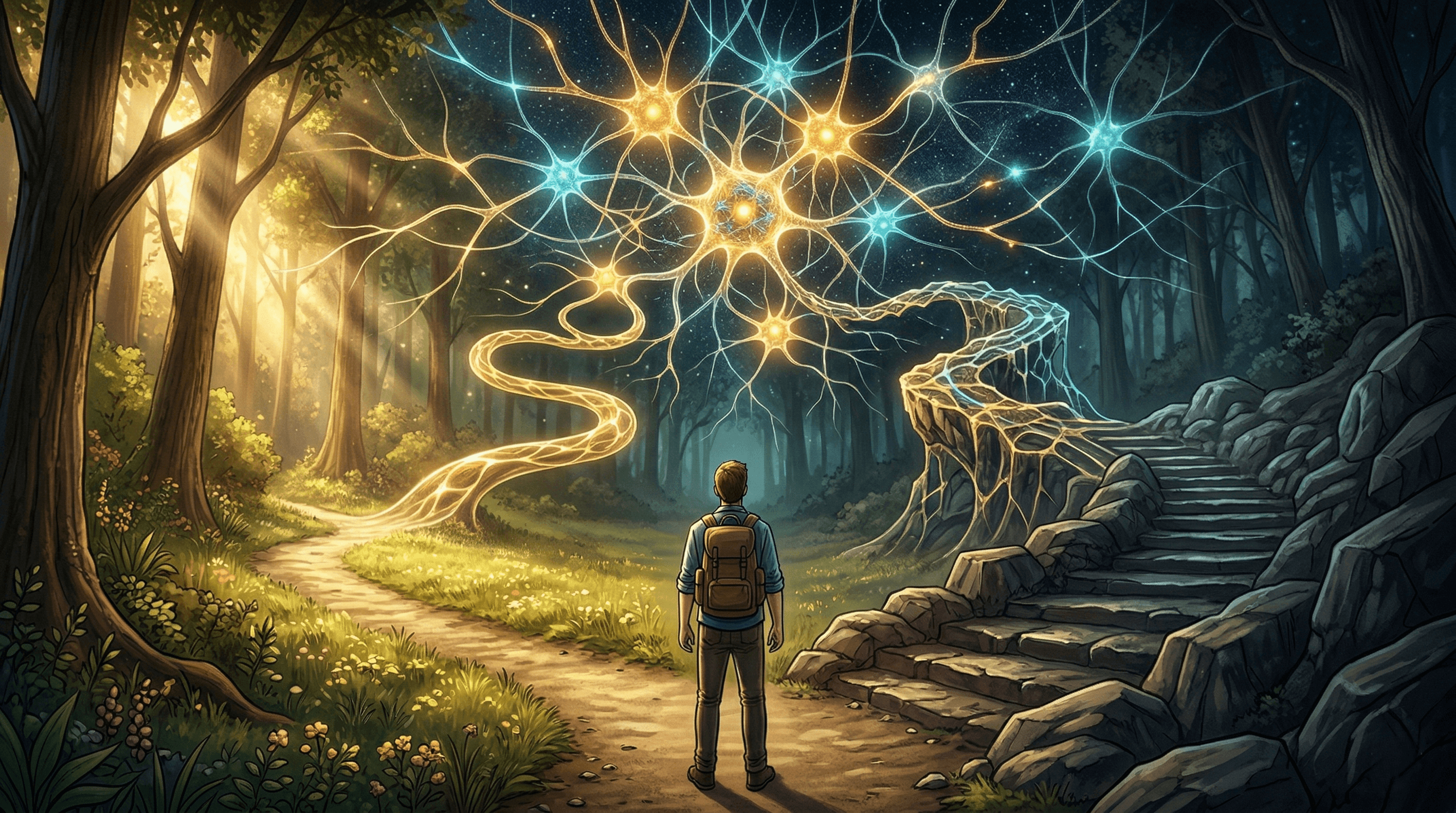
Dr. Joe Dispenza, a researcher in neuroscience and epigenetics, has shown through brain imaging studies that when a person mentally rehearses a new identity, truly feels and embodies the emotions of the person they want to become, their brain begins to physically reorganize. New neural connections form. The brain does not distinguish between a vividly imagined experience and a real one. Your hardware starts updating before your circumstances do.
This is not visualization as wishful thinking. This is neuroplasticity, the brain's proven ability to rewire itself based on repeated thought patterns. Dr. Andrew Huberman at Stanford has explained that the combination of focused attention and emotional engagement is what triggers the release of neurochemicals like dopamine and acetylcholine, which literally mark neural circuits for change.
Then there is the Reticular Activating System. The RAS. This is a network of neurons at the base of your brainstem that acts as a filter for the roughly 11 million bits of information hitting your senses every second. It decides what gets through to your conscious awareness and what gets deleted.
Here is the key. Your RAS filters based on identity.
If you believe you are someone who struggles with money, your RAS will filter out opportunities, ideas, and connections that could change your financial life. Not because they are not there. Because your identity told your brain they are not relevant.
Change the identity, and the RAS recalibrates. You start noticing what was always there. The opportunities. The people. The doors. Nothing in your external environment changed. The observer changed.
I explored this mechanism deeply in the neuroscience of why you're stuck. The RAS is the gatekeeper. And your identity holds the key.
The Identity Selection Problem
Here is where most people get trapped. They understand the concept intellectually. They agree that identity matters. But they keep running the old software because changing identity feels abstract.
"Become the person who already has what you want." Great. But how?
The answer is not as mystical as it sounds. Your identity is not some fixed, cosmic thing that was assigned to you at birth. It is a collection of beliefs about yourself that were installed over time through repeated experiences, repeated thoughts, and repeated actions.
You were not born believing you are bad with money. That belief was installed. Maybe by watching your parents argue about bills. Maybe by a string of financial setbacks. Maybe by the story you told yourself after each one. "I am just not good with money." That sentence, repeated enough times, became neural infrastructure. It became identity.
And now your RAS filters everything through that lens. You miss the investment opportunity because your brain flagged it as "not for people like you." You underprice your services because your identity says you are not worth more. You stay in a job you've outgrown because your identity says this is your ceiling.
The installed identity is running the show. And it will keep running the show until you install a new one.
The Mechanism of Change
So if identity is the operating system and your brain is the hardware that runs it, how do you actually change the software?
Not with a vision board. Not with affirmations you do not believe. With decisions.
James Clear put it precisely in Atomic Habits: "Every action you take is a vote for the type of person you wish to become." He is right. But most people are casting votes for their old identity without realizing it. Every time you hit snooze, you vote for the person who does not follow through. Every time you scroll instead of starting, you vote for the person who avoids discomfort.
The votes are happening whether you are conscious of them or not. The question is whether you are voting on purpose or by default.
Your One Move
Make a single decision today as the version of you that already has what you want.
Not a massive overhaul. One choice. Right now.
That version does not hit snooze. So tomorrow morning, you do not.
That version does not open Instagram before their morning routine. So tomorrow, you do not either.
That version talks about their business in present tense, not "someday" language. So today, you start.
That version walks into a room like they belong there. So the next room you walk into, you do.
One decision made from that identity rewires the neural pathway. The RAS adjusts. The filter updates. You start collapsing a different reality. Not through magic, but through the most well-documented mechanism in neuroscience: repeated identity-aligned action.
This is the same protocol I break down in how to actually achieve your goals. Define the identity first. Then let the behavior follow. Not the other way around.
Why Affirmations Alone Do Not Work
Let me address something that most people get wrong about identity change.
Standing in front of a mirror saying "I am wealthy, I am powerful, I am unstoppable" while your life evidence says otherwise does not work. Your brain is not stupid. It compares the affirmation against the stored evidence and rejects the mismatch. This creates cognitive dissonance, which actually reinforces the old identity because your brain resolves the conflict by siding with what it already believes.
What does work is what Dispenza calls "rehearsal with feeling." You do not just say the words. You sit with the emotion of what it would feel like to already be that person. You feel the confidence. You feel the calm. You feel the certainty. And you hold that state long enough for your brain to start forming new associations.
Then you act from that state. Immediately. Before the old identity can pull you back.
The combination of emotional rehearsal plus immediate action is what creates the fastest identity shift. Not one or the other. Both. The feeling primes the neural circuits. The action locks them in.
The Evidence from My Own Life
This maps to something I have believed since I was five years old.
I was raised in Cuiabá, Brazil, going to a spiritist center rooted in the teachings of Jesus. Not a religion. A doctrine. A way of seeing life. The core belief planted in me at age five: you are a spiritual being here to evolve. Energy and frequency. What you transmit, you receive. You are the creator of your reality.
I did not have the vocabulary for it then. Neuroscience and quantum physics gave me the vocabulary now.
When I was driving Uber at 2 AM, broke, filming myself with a cracked phone talking to a version of me nobody around me believed was real, I was not being delusional. I was doing exactly what Dispenza's research describes. I was mentally rehearsing an identity. I was casting votes for a person who did not exist in my environment yet. I was rewiring my RAS to filter for a different reality.
And my brain could not tell the difference between the version I was rehearsing and the version I was living. So it started building the bridge.
The science is catching up to what my mother planted in me at age five in that spiritist center in Cuiabá.
Why Environment Accelerates Everything
Identity shifts do not hold in isolation. Your brain is wired to mirror the people around you. Mirror neurons literally cause you to adopt the beliefs, habits, and emotional states of whoever you spend the most time with.
You can rehearse a new identity every morning. But if you spend the rest of the day surrounded by people who operate from the old one, your brain will default back. The environment wins. Every time. This is why I wrote the cage is the problem. Environment is stronger than willpower.
The fastest way to lock in a new identity is to place yourself in a room where that identity is the standard, not the exception. Where the people around you are already voting for the version of themselves they want to become. Where the conversations, the challenges, and the standards reinforce the new software you are trying to install.
That is why The 1% Club exists. Seven rooms designed around the seven dimensions of growth: Mindset and Identity, Health and Fitness, Inner Life, Discipline and Execution, Money and Business, Communication and Influence, and Creator Lab. Weekly live masterclasses. Direct access to me. Weekly challenges. And a community of people who are actively voting for their next identity, not their old one.
The Question I Want You to Sit With
What version of yourself do you keep seeing in your head? The one you know exists but have not become yet?
Close your eyes for ten seconds. See that person. Feel what they feel. Notice how they carry themselves. Notice what they believe about what is possible.
Now open your eyes and ask yourself one question.
What would that person do right now?
Whatever the answer is, do that. One vote. One neural pathway. One crack in the old identity.
Your future self is not waiting for you somewhere in the distance. They are standing right next to you, separated by nothing but the decisions you make today.
Start voting.