
The Physics Experiment That Explains Why You're Stuck
In 1927, scientists discovered that observing a particle changes its behavior. Nearly 100 years later, neuroscience confirms the same principle applies to your brain. What you choose to observe becomes who you become. Here is the science behind identity collapse.
The Experiment That Broke Physics
In 1927, scientists fired particles through two slits in a wall.
Without anyone watching, the particles did something impossible. They behaved like waves. They spread out. They existed in multiple places at once, passing through both slits simultaneously, as if reality itself had not decided what they were yet.
Then someone watched.
The moment an observer was introduced, the particles collapsed. One position. One path. One outcome. The act of observation literally changed what was real.
This is one of the most replicated experiments in the history of physics. Nearly 100 years later, scientists still cannot fully explain why it happens.
Now, I am not telling you that you can quantum leap into a new life by thinking hard enough. That is not how physics works.
But as a philosophical lens, this experiment describes something about your life that neuroscience is now confirming in the lab.
The Neuroscience That Makes This Real
Here is where it moves from philosophy to hard science.
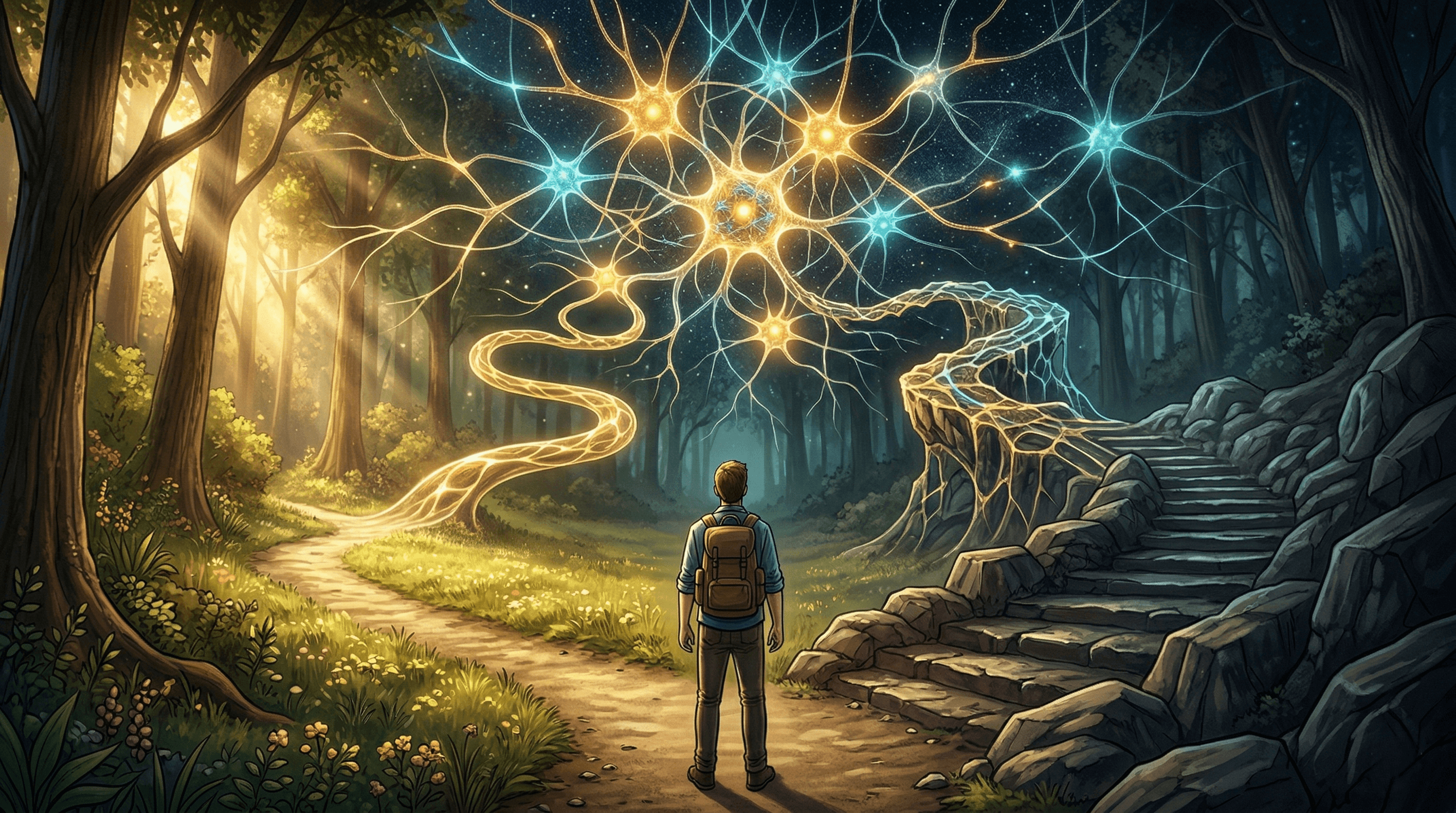
Researchers at University College London found that the brain physically rewires its neural pathways based on what receives focused, repeated attention. This is not a theory. It has been measured. The neurons that fire together literally form stronger connections, and the ones you ignore weaken and eventually dissolve.
Dr. Andrew Huberman calls this the foundation of neuroplasticity: your brain does not distinguish between what is real and what is vividly imagined and repeatedly rehearsed. The neural pathways form either way.
Think about what this means for the version of you that exists right now.
Every day, your brain is observing something. The question is whether you are choosing what it observes, or whether your environment is choosing for you.
Most people never make that choice. They wake up, react, scroll, respond, sleep, repeat. Their attention is scattered across a thousand inputs. No conscious direction. No deliberate focus. Like an unobserved particle, their potential stays spread across every direction at once.
Nothing collapses into anything specific because nobody is watching.
I explored how your environment hijacks this process in why your brain is hijacked, not lazy. The dopamine system that controls your attention is being manipulated before you even realize it.
You Are Not Discovering Who You Are. You Are Collapsing Who You Become.
This is the part that should unsettle you.
Every version of you already exists as a possibility right now. The one who built the business. The one who stayed comfortable. The one who figured out discipline. The one who spent another year planning to start.
Which one becomes your actual life depends entirely on where you point your attention and how honestly you observe yourself.
James Clear wrote it plainly: every action is a vote for the type of person you wish to become. Neuroscience now shows us why that is literally true. Each repeated thought, each repeated behavior, each moment of focused attention is physically wiring your brain to become that version of you. Not metaphorically. Structurally.
The person who checks their phone 96 times a day is not just wasting time. They are casting 96 votes for a scattered, reactive identity. Their brain is building the architecture of someone who cannot focus, who cannot sit with discomfort, who cannot start something hard.
The person who sits down for 30 minutes of focused work every morning before touching a screen is casting a different vote entirely. Same brain. Same 24 hours. Completely different architecture being built.
You are the observer. And what you choose to observe becomes what you are.
This is the same principle behind the invisible prison most people live in. The walls are not external. They are the neural pathways you have been reinforcing without realizing it.
The Identity Collapse Framework
Let me break this down into something you can use.
Stage 1: Scattered potential. You have ambitions, ideas, goals, but they exist as vague possibilities. You have not committed to any single direction with enough focus to make it real. Your attention is spread thin. You consume content about success, fitness, discipline, business, but none of it sticks because you are observing everything and collapsing nothing.
Stage 2: Conscious observation. You pick one identity and start watching yourself through that lens. Not hoping. Not wishing. Observing. You notice when your behavior aligns with that identity and when it does not. You stop running from the gap between who you are and who you want to be. You sit in it.
Stage 3: Neural rewiring. Through repeated, focused attention on the behaviors that match your chosen identity, your brain starts building new pathways. The old patterns weaken. The new ones strengthen. This is not instant. It takes weeks of consistent observation. But the science is clear: the wiring changes.
Stage 4: Identity collapse. The possibility becomes the reality. Not because you manifested it. Because you observed it into existence through thousands of small, deliberate actions that physically restructured your brain.
This is exactly what I laid out in your future self already exists. The version of you that has everything you want is not some distant fantasy. It is a neural pattern waiting to be activated.
Why Environment Determines Which Version Wins
Here is the part most people miss.
You can observe perfectly. You can set intentions every morning. You can journal, meditate, and visualize. But if your environment keeps triggering the old neural pathways, the new ones will never gain enough strength to take over.
Your brain does not just mirror your own thoughts. It mirrors the people around you. Mirror neurons cause you to adopt the beliefs, behaviors, and emotional states of whoever you spend the most time with. Huberman, Clear, every serious researcher on behavior change says the same thing: environment is stronger than willpower.
I wrote about this in depth in the cage is the problem. The rats in Rat Park did not have more discipline. They had a better environment. And that environment changed their brain chemistry.
The same is true for you. You can be the most conscious observer in the world, but if you are surrounded by people who reinforce your old identity, your brain will keep defaulting to the old pathways. This is not weakness. This is neuroscience.
The Observer Protocol: Your One Move for the Next 24 Hours
Set three alarms on your phone. Random times throughout the day.
When each one goes off, stop whatever you are doing and answer one question in your notes app:
"What pattern is running me right now?"
Not what you are doing. What is operating underneath it. Name the pattern, not the activity.
Do not judge it. Do not fix it. Just observe it and write it down.
Three observations in one day. That is all.
Here is why this works: your brain cannot run a pattern and observe it at the same time. The moment you name the pattern, you interrupt the autopilot. You become the conscious observer. And that, as the science shows, is when reality starts to shift.
Most people will read this and think "interesting" and never set the alarms. The ones who actually do it will feel something change by the third alarm. The difference is not information. It is action.
If you want to take this further, I built a free tool called The 15 Minute Brain Audit that maps exactly which patterns are running your life and where the damage is. And if your score is above 75, The Dopamine Reset is the 7 day protocol to rewire them.
The Room Where Observers Become Builders
Self observation is the beginning. But sustaining it alone is nearly impossible.
This is why I built The 1% Club. It is the room where conscious observers do the work together. Weekly masterclasses. Direct access to me. Seven rooms of growth. Weekly challenges. And a community of people who are actively building a new identity, not just talking about it.
If you have been reading these articles and feeling the shift but struggling to make it stick, the missing piece is not more knowledge. It is the environment.
You are the observer. The question is whether you are observing alone in a room full of noise, or observing alongside people who sharpen your focus.
The Question I Want You to Sit With
What is one pattern you already know is running you but have not named out loud yet?
Sometimes just naming it is the first real observation. And that is where the collapse begins.
Your potential is not something you find. It is something you collapse into reality by choosing where to look. The particles proved it. The neuroscience confirmed it. Now it is your turn.