
How to Fix Your Entire Life in 1 Day
Dan Koe's viral article hit 176 million views. Here are the 7 ideas that explain why you're stuck and the exact framework to rebuild your life from the identity level up, starting today.
Dan Koe published an article on X that exploded to 176 million impressions and 292,000 likes in less than a month. One article. No paid promotion. No algorithm hack. Just ideas that hit so deep that millions of people couldn't stop sharing them.
I spent days breaking down that article, pulling out the 7 most powerful ideas, and adding the frameworks I've used to actually implement them. This isn't motivation. This is a blueprint for rebuilding your life from the identity level up.
If you're stuck between your potential and your reality, this was made for you.
Point 1: You Aren't Who You Need to Be Yet
This is the idea that changes everything once you truly understand it. Most people set goals as the version of themselves they are right now. They try to bolt new behaviors onto an old identity. And it never works.
You can't achieve a six-figure income with an employee mindset. You can't build a great body with a person-who-hates-the-gym identity. You can't create meaningful work while identifying as someone who is "not creative."
As James Clear writes in Atomic Habits: "Every action you take is a vote for the type of person you wish to become." But here's what most people miss. Your current actions are also votes. And right now, they're voting for the person you already are.
The shift isn't behavioral. It's existential. You don't need to do different things. You need to become a different person. The doing follows naturally.
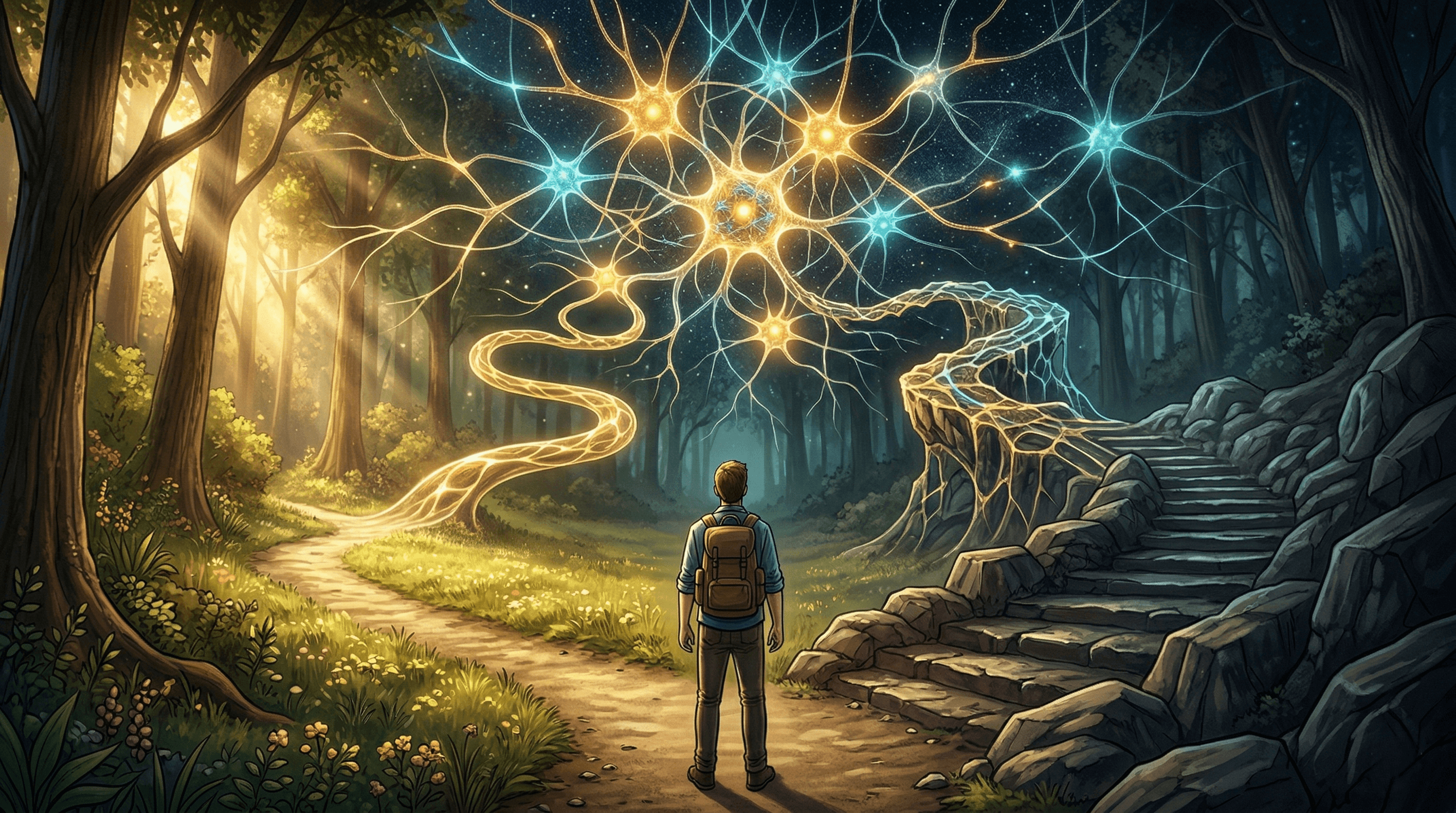
I explored the neuroscience behind this in why you're actually stuck. Your brain's Reticular Activating System literally filters reality based on your identity. Change the identity, and your brain starts showing you a different world.
How to apply this today:
Write down the identity of the person who has already achieved what you want. Not the goal. The person. "I am someone who trains every day." "I am someone who builds, not consumes." "I am someone who shows up regardless of how I feel." Then ask yourself: what would that person do right now? Do that. One vote at a time.
Point 2: You Don't Actually Want What You Think You Want
Most people's goals aren't their own. They're borrowed. They come from parents, society, social media, and the unconscious absorption of what everyone else seems to want.
"I want to be rich." Do you? Or do you want freedom? "I want a six-pack." Do you? Or do you want confidence? "I want a million followers." Do you? Or do you want to feel like your voice matters?
When you chase borrowed goals, you feel hollow even when you achieve them. That emptiness isn't a sign of failure. It's a sign that you succeeded at the wrong thing.
Naval Ravikant says: "Desire is a contract you make with yourself to be unhappy until you get what you want." The question is whether you're making that contract for something that will actually fulfill you, or for something you were programmed to chase.
How to apply this today:
Take every goal you have and ask "why?" five times. "I want to make $100K." Why? "So I can quit my job." Why? "So I have freedom." Why does freedom matter? Keep going until you hit the real desire underneath. That's what you should be building toward. Everything else is noise.
Point 3: Fear Was Programmed Into You
You weren't born afraid of failure. You weren't born afraid of judgment. You weren't born afraid of putting yourself out there. Watch any toddler. They try everything. They fail constantly. They don't care who's watching. Fear of failure is learned behavior, installed by years of conditioning.
Every time someone told you to "be realistic." Every time a teacher punished the wrong answer instead of celebrating the attempt. Every time you watched someone get ridiculed for trying something different. Your brain cataloged each of those moments and built a threat map: trying = danger.
This is the amygdala at work. Your brain's threat detection system doesn't distinguish between a physical threat and a social one. Getting laughed at triggers the same stress response as being chased by a predator. Cortisol floods your system. Your prefrontal cortex (the rational part) goes offline. And you freeze, flee, or fight.
The fear you feel before posting that video, launching that project, or having that hard conversation isn't real danger. It's a ghost from childhood pretending to protect you.
How to apply this today:
Name one thing you've been avoiding because of fear. Not a vague thing. A specific action. "I'm afraid to post my first video." "I'm afraid to ask for the raise." "I'm afraid to leave this relationship." Now ask: "What is the actual worst-case scenario?" Write it down. You'll realize it's almost always survivable. The fear is bigger than the thing.
Point 4: The 9 Levels of Mind Development
This was the most eye-opening part of Dan Koe's article. He describes nine levels of mind development, from pure survival mode to creative mastery. Most people are stuck between levels 3 and 5: they've moved past basic survival but they're trapped in social conformity, trying to fit in, seeking approval, and measuring themselves by other people's standards.
The levels roughly map like this:
Levels 1-3 (Survival): You're reacting to life. Bills, drama, putting out fires. No space for growth because all your energy goes to not drowning.
Levels 4-6 (Conformity): You're stable but stuck. You follow the rules. You do what's expected. You optimize within the box society built for you. You might be "successful" by external measures but feel empty inside.
Levels 7-9 (Creation): You're building your own reality. You've stopped asking permission. You create value on your terms. Your work is an expression of who you are, not a reaction to what others expect.
The jump from conformity to creation is the hardest because it requires you to stop caring about what everyone else thinks. And that feels like death to the social brain that's been keeping you safe since childhood.
How to apply this today:
Honestly assess which level you're operating at. Not where you want to be. Where you actually are. Are you still reacting to life? Are you optimizing within someone else's framework? Or are you building something that's authentically yours? There's no judgment in the answer. But you can't navigate if you don't know your starting point.
Point 5: What Real Intelligence Actually Means
Naval Ravikant defines intelligence not as IQ, grades, or credentials. He defines it as "the ability to see through the social programming that was installed in you."
Think about that. Most of what you believe about success, money, work, relationships, and happiness was installed before you were old enough to question it. By your parents. By your teachers. By your culture. By the media you consumed.
Real intelligence isn't knowing more. It's unlearning more. It's the ability to look at a belief you've held your entire life and ask: "Is this actually true? Or did someone just tell me it was?"
"You need a degree to succeed." Is that true? Or is that what the education system told you? "Money is the root of all evil." Is that true? Or is that what people without money say to feel better? "It's too late to start." Is that true? Or is that fear dressed up as wisdom?
I covered this in 5 personal development lies you probably believe. So much of what holds us back isn't reality. It's programming we never questioned.
How to apply this today:
Write down three beliefs that govern your life right now. "I need to work hard to earn money." "I'm not a creative person." "People like me don't get opportunities like that." Now ask for each one: "Who installed this belief? And is it actually serving me?" You might be shocked at how many of your "truths" are just inherited limitations.
Point 6: How to Launch a New Life in 1 Day
This is the actionable core. Not "change your life gradually over 6 months." One day. Here's the three-phase protocol:
Phase 1: Deconstruct (Morning)
Spend 2-3 hours writing. Not planning. Not goal-setting. Writing about who you currently are and why. What beliefs are running your life? What identity are you operating from? What patterns keep repeating? What are you tolerating that you shouldn't be? This is the audit. You can't rebuild what you haven't honestly examined.
Phase 2: Architect (Afternoon)
Design the identity you want to become. Not the goals. The person. What does this person believe? How do they spend their mornings? What do they refuse to tolerate? What are their non-negotiable daily habits? Write it out in vivid detail. This becomes your blueprint.
Phase 3: Execute (Evening)
Take one action that the new identity would take but the old identity never would. It doesn't have to be massive. Post the video. Sign up for the gym. Send the email. Start the project. Have the conversation. One action that proves to your brain: "We're different now." That single action creates a crack in the old identity. And cracks compound.
This isn't about willpower. As I wrote in how I hacked my brain to stop being lazy, it's about removing the friction between you and the action. The protocol works because it moves you through understanding, design, and action in a single day instead of spreading it across weeks where life gets in the way.
Point 7: Turn Your Life Into a Video Game
This was the idea that tied everything together. Dan Koe argues that the reason video games are so addictive is that they give you six things that most people's real lives don't:
1. A clear character to develop. In a game, you know exactly who you're building. In life, most people have no idea who they're trying to become.
2. Defined skills to level up. Games show you exactly which stats to improve. In life, people work on random things with no progression system.
3. Quests with clear objectives. Games give you missions with defined outcomes. In life, most people wander without clear daily missions tied to bigger goals.
4. Immediate feedback loops. Games tell you instantly whether you succeeded or failed. In life, feedback is delayed by weeks or months, killing motivation.
5. A community of other players. Games connect you with people on the same journey. In life, most people are surrounded by people who aren't playing the same game.
6. Increasing difficulty that matches your level. Games scale the challenge so you're always in the zone between boredom and overwhelm. In life, people either coast (bored) or take on too much (burned out).
The framework is simple: treat your real life like you treat a game you're obsessed with.
Define your character (identity). Choose your skill tree (focus areas). Set daily quests (non-negotiables). Build in XP tracking (weekly reviews). Find your guild (community). And keep increasing the difficulty as you level up.
How to apply this today:
Open a note and create your "character sheet." Name: you. Class: the identity you're building toward. Top 3 skills to level up this quarter. Daily quests (2-3 non-negotiable actions). Weekly boss fight (one hard thing you've been avoiding). Track your XP. It sounds silly until you try it and realize it makes the grind feel like play.
Why This Went Viral
176 million impressions. 292,000 likes. From one article. No ad spend. No clickbait. No controversy.
It went viral because it named what millions of people feel but can't articulate: the gap between their potential and their reality. Most people know they're capable of more. They feel it. But they don't have the framework to close the gap. They have motivation without a map.
This article gave them the map. Not a vague "believe in yourself" map. A specific, level-by-level, phase-by-phase map for going from stuck to building.
The 7 ideas aren't revolutionary in isolation. Identity-based change. Questioning inherited beliefs. Environment design. Community. These are principles that have been taught for decades. What made it hit was the combination: all seven ideas, woven together into a single coherent framework that a person could read in 15 minutes and start implementing immediately.
That's the power of synthesis. Not saying something new. Saying something true in a way that finally lands.
Your Move
You've now read the framework. You understand the 7 ideas. You know that identity drives behavior, that fear is programmed, that intelligence means unlearning, that your life can be redesigned in a single day if you choose to do it.
The question is the same one it always is: what will you do with what you now know?
Information without action is entertainment. You've been entertained enough. Pick one idea from this article. The one that hit hardest. And implement it before midnight tonight. Not tomorrow. Not next week. Tonight.
One vote for the person you're becoming. That's all it takes to start.