
Scientists Found the Real Reason You're Stuck
Your brain is listening to everything you say, and it's building your life based on what it hears. The neuroscience behind identity, beliefs, and why environment changes everything.

Most people think success starts with action. Wake up earlier. Work harder. Grind more. But neuroscience says something different. Success starts with a thought. Not a motivational quote on your phone. An actual, repeated thought pattern that physically rewires your brain.
The Science Most People Ignore
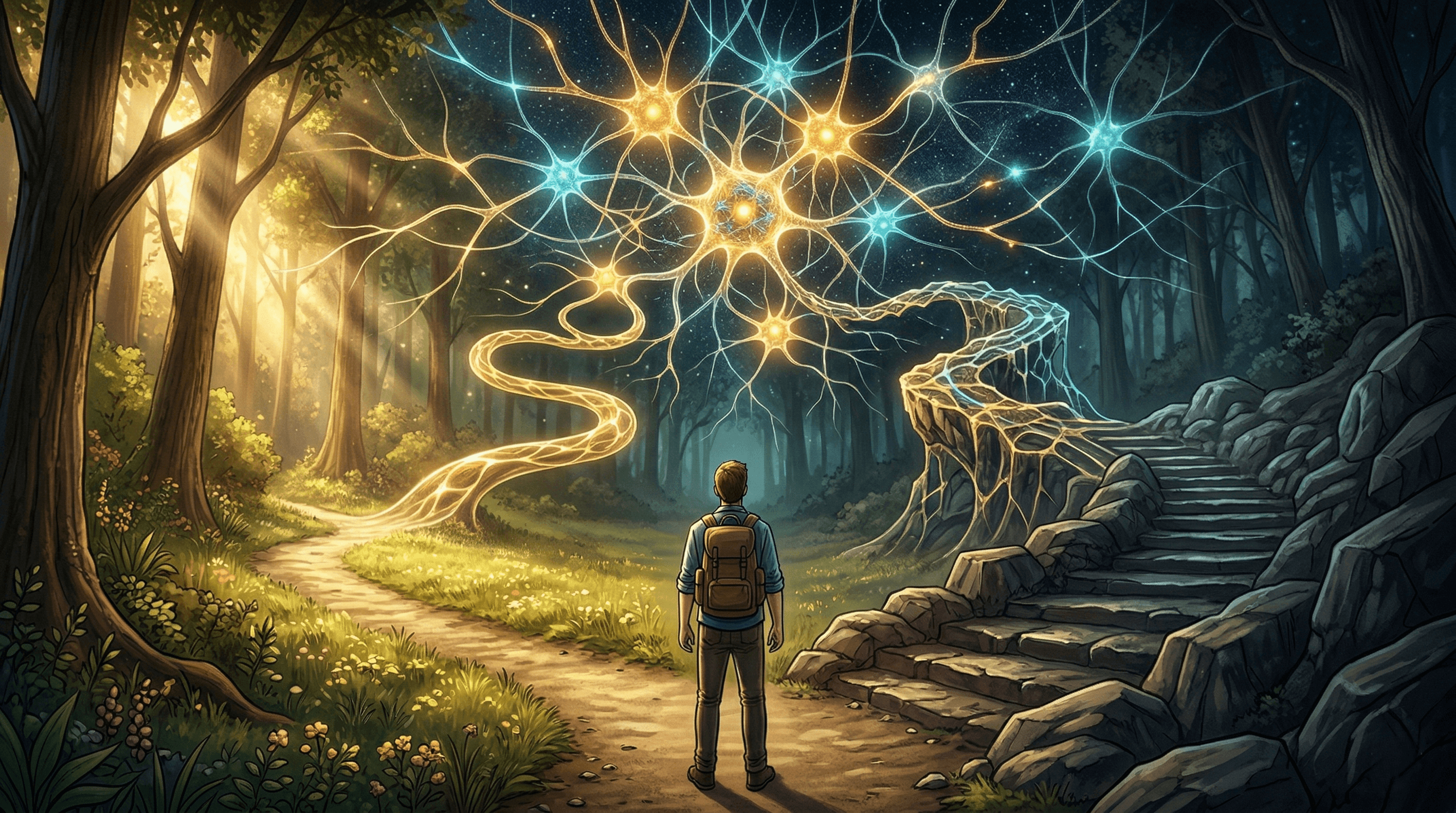
Your brain has roughly 86 billion neurons. Every time you think a thought, those neurons fire together and form connections. Neuroscientists call this neuroplasticity.
Here's the part that changes everything: the more you repeat a thought, the stronger that neural pathway becomes. Think of it like a trail in a forest. Walk it once, and you barely leave a mark. Walk it a thousand times, and it becomes a road.
Dr. Joe Dispenza, one of the leading researchers on the brain and change, puts it simply: "Your personality creates your personal reality."
That means the thoughts you repeat become beliefs. Your beliefs become your identity. And your identity determines what you do, what you tolerate, and what you pursue. This isn't philosophy. This is biology.
What Happens Inside Your Body When You Believe
When you hold a negative belief about yourself ("I'm not smart enough," "I'll never make it," "People like me don't succeed"), your brain triggers your amygdala. That's your threat detection system. The result? Your body floods with cortisol and adrenaline. Stress hormones. Your muscles tighten. Your digestion slows. Your immune system weakens.
Dr. Bruce Lipton, a cell biologist from Stanford, proved that your cells literally respond to your thoughts. His research in epigenetics showed that beliefs and perceptions can activate or deactivate genes. Your DNA is not your destiny. Your thoughts are.
Now flip it. When you genuinely believe something positive about yourself and your future ("I'm capable," "I will figure this out," "I belong in rooms that challenge me"), your brain releases dopamine, serotonin, and oxytocin.
These chemicals don't just make you "feel good." They sharpen your focus. They increase creativity. They improve decision making. They boost your immune system. They literally give your body the chemistry it needs to perform at its highest level.
Same brain. Same body. Completely different chemical environment. The only thing that changed? The thought.
Your Brain Has a Filter (And It's Controlled by Your Beliefs)
There's a system in your brainstem called the Reticular Activating System (RAS). Its job is simple: filter information.
Your brain receives roughly 11 million bits of information per second, but you can only consciously process about 50. So the RAS decides what gets through. And here's the key: it prioritizes whatever matches your existing beliefs.
If you believe opportunities never come your way, your RAS will literally filter them out. They'll be right in front of you and you won't see them. If you believe you're the kind of person who finds solutions, your RAS starts scanning for them. Constantly. Automatically. Without you even trying.
This is why two people can be in the exact same room, the exact same situation, and one sees nothing while the other sees everything. It's not luck. It's programming. And you are the programmer.
Identity Is the Real Starting Point
James Clear wrote about this in Atomic Habits. The most effective way to change your behavior isn't to focus on goals. It's to change your identity. If you want to go deeper on this, read our guide on how to actually achieve your goals.
A person who identifies as "someone trying to quit smoking" still sees themselves as a smoker. A person who says "I'm not a smoker" has shifted their identity. The behavior follows naturally.
Neuroscience backs this up completely. When your identity shifts, your brain starts filtering reality differently through the RAS, producing different chemicals through your endocrine system, and creating different habits through neuroplasticity.
Everything changes. Not because the world changed. Because you changed first. Your body follows your mind. Your habits follow your identity. Your results follow your beliefs. It always starts in the mind.
So What Do You Do With This?
You protect your inner world like your life depends on it. Because it does.
The conversations you have with yourself when no one is around? Those are building neural pathways. The identity you hold when things get hard? That's programming your RAS. The beliefs you carry about what you deserve and what's possible? Those are sending chemical signals through your entire body right now.
This is exactly why environment matters so much. When you're surrounded by people who think bigger, your brain starts to mirror those patterns. Neuroscience calls this the mirror neuron system. You don't just observe the people around you. Your brain literally simulates their mindset, their behavior, their standards.
You become what you're surrounded by. Not because of motivation. Because of biology.
Why Environment Is the Fastest Way to Change
Once you understand how your brain actually works, you realize that the fastest way to change your life isn't a new strategy. It's a new environment.
Better conversations. Higher standards. People who operate with intention instead of autopilot. When your environment feeds your mind, challenges your identity, and keeps you in a chemical state of growth instead of survival, everything shifts.
This is exactly why The 1% Club exists. It's a designed environment where your brain gets the inputs it needs to rewire. Every room inside the club is structured to challenge your thinking and raise your standards. Because the science is clear: change your environment, change your brain, change your life.