
The Invisible Prison You Built for Yourself
A 1967 psychology experiment revealed why most people stop trying even when the exit is right in front of them. The victim mindset is the most dangerous pattern you don't know you have. Here's how to break free.

Last week I talked about how the words you say about yourself are quietly destroying your progress.
This week, I want to go deeper.
Because there's something even more dangerous than negative self-talk. Something that silently eats away at your potential, your relationships, your career, and your health, while making you feel like none of it is your fault.
It's called the victim mindset.
And before you say "that's not me," stay with me. Because this isn't about people who've been through real trauma. This is about a pattern of thinking that most people don't even realize they've adopted. A pattern that turns your entire life into something that happens to you, instead of something you create.
The Experiment That Explains Everything
In 1967, psychologist Dr. Martin Seligman at the University of Pennsylvania ran one of the most important experiments in the history of psychology.
He placed dogs into two groups. One group could stop mild electric shocks by pressing a lever. The other group had no control. The shocks came and went randomly, no matter what they did.
Then both groups were moved to a new environment where all of them could easily escape by jumping over a small barrier.
The dogs who previously had control? They jumped immediately.
But the dogs who had been conditioned to believe nothing they did mattered? They laid down. They didn't even try. The exit was right there and they didn't move.
Seligman called this Learned Helplessness. And follow-up studies confirmed the same thing happens in humans.
When people are repeatedly exposed to situations where their actions seem to have no effect, they stop trying. Even when the situation changes. Even when they absolutely could succeed.
How Your Brain Builds a Prison
Think about how powerful that is.
A few repeated experiences of powerlessness. A toxic job where nothing you suggested was ever heard. A controlling relationship where your opinions were dismissed. A string of failures where the timing was always wrong. And your brain starts writing a story: "Nothing I do matters. The world is against me. This is just how my life is."
Once that story takes root, it bleeds into everything. You stop going after the promotion. You stop posting the content. You stop trying in your relationships. You stop betting on yourself.
Not because you can't. Because you've been trained to believe you can't.
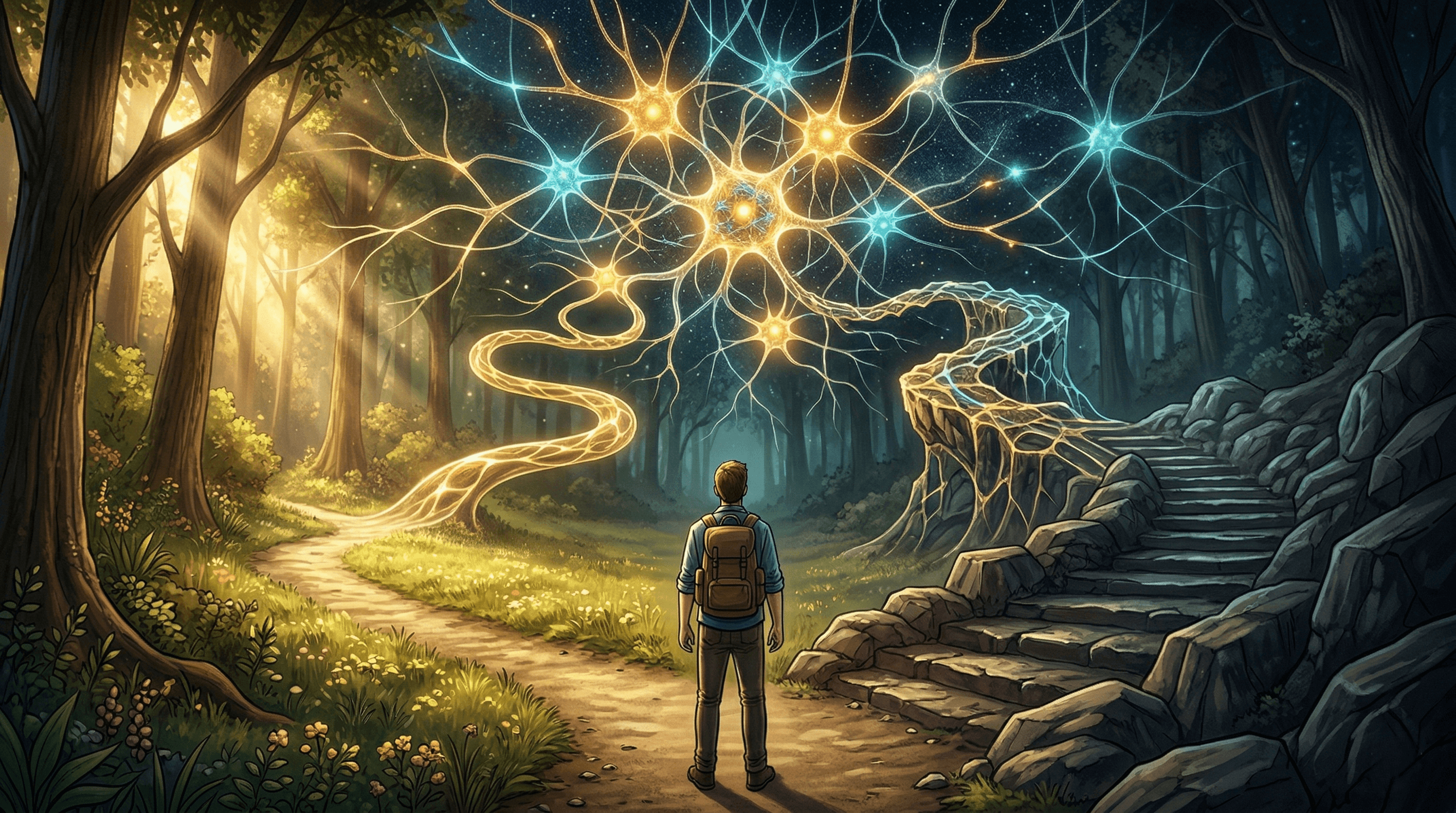
This is exactly what I explored in the neuroscience of why you're stuck. Your brain's Reticular Activating System (RAS) filters reality based on your existing beliefs. If you believe nothing works out for you, your RAS will literally filter out the evidence that things could work. Opportunities will be sitting right in front of you and your brain won't register them. Not because they're invisible. Because your belief system has made them invisible.
The dogs in Seligman's experiment could see the barrier. They could see other dogs jumping over it. The exit was obvious. But their conditioning had built an invisible wall that was stronger than the physical one.
That invisible wall is the victim mindset. And it's built one thought at a time.
The Five Signs You Don't Know You Have It
The victim mindset isn't always obvious. It doesn't always look like someone crying in the corner blaming the world. More often, it hides behind perfectly reasonable explanations.
1. You explain more than you execute. You have a detailed explanation for why things haven't worked out. The economy. The algorithm. Your upbringing. Your boss. Your location. The explanation is always polished, always logical, and always focused on something outside of your control. Meanwhile, the person next to you with the same obstacles is building anyway.
2. You compare down instead of up. You look at people who have it worse and use that as permission to stay where you are. "At least I have a job." "At least I'm not in debt." This feels like gratitude but it functions as a ceiling. Real gratitude says "I appreciate what I have AND I'm going for more." The victim mindset says "I appreciate what I have SO I should stop pushing."
3. You avoid feedback. You interpret constructive criticism as a personal attack. When someone points out a flaw in your work, your first instinct is to defend, not to learn. This is because the victim identity is fragile. It can't tolerate the idea that you might be the variable that needs changing.
4. You bond over complaints. Pay attention to your conversations this week. How many of them revolve around what's wrong? The weather. The government. The traffic. Your coworkers. Complaining feels like connection, but it's actually just shared helplessness. Two people agreeing that things are bad reinforces the belief that things can't change.
5. You use "I can't" when you mean "I won't." There's a massive difference between these two statements. "I can't wake up early." No. You won't. "I can't afford to invest in myself." No. You've chosen to spend that money elsewhere. "I can't find time to work out." No. You haven't made it a priority. The language of "can't" removes agency. The language of "won't" gives it back. Most people don't realize how often they use one when they mean the other.
The Same Event, Two Completely Different Lives
Here's what nobody tells you. There is no single reality.
The same event, a rejection, a failure, a breakup, a setback, can be interpreted in completely different ways by two different people. One person gets fired and spirals for a year. Another gets fired and builds the business they were always too comfortable to start.
Same event. Opposite outcomes.
The difference isn't talent, luck, or privilege. It's the story they chose to tell themselves about what happened.
The victim says: "This happened to me."
The builder says: "This happened for me."
That's not toxic positivity. That's a fundamental shift in how you relate to your own life. It's the difference between being a passenger and being the driver.
And here's the real part that changes everything. Once you make that shift, you start noticing something strange. Opportunities show up that were always there but you couldn't see. People respond to you differently. Doors open. Not because the world changed. Because you did.
As James Clear wrote in Atomic Habits: every action you take is a vote for the type of person you wish to become. And every time you choose to blame, complain, or give your power away to circumstances, you're voting for the identity of a victim. Every time you choose to own it, learn from it, and move forward, you're voting for the identity of someone who creates their reality.
The Neuroscience of Ownership
This isn't just philosophy. There's hard neuroscience behind why taking ownership literally changes your brain.
When you believe you have control over your outcomes, your prefrontal cortex (the decision-making center) stays active. You think clearly. You plan. You problem-solve. You see options.
When you believe you have no control, your amygdala takes over. You enter threat mode. Cortisol floods your system. Your thinking narrows. You see only problems, never solutions. Your brain literally shuts down the part of itself that could help you escape.
This is Seligman's experiment playing out in real time inside your skull. The "shocks" in your life (the rejections, the failures, the setbacks) aren't what trap you. It's the belief that nothing you do about them will matter.
Dr. Carol Dweck's research at Stanford on growth mindset confirms this from a different angle. People who believe their abilities are fixed ("I'm just not smart enough," "I'm not a natural leader") perform significantly worse than people who believe their abilities can develop through effort. Same person. Same brain. Different belief about whether their actions matter. Completely different results.
Your belief about agency isn't a preference. It's a biological switch that determines which parts of your brain are active and which are suppressed.
How to Break Out of Learned Helplessness
If you recognized yourself in any of the five signs above, don't spiral about it. Awareness is the first step, and most people never get there. The dogs in Seligman's experiment couldn't become aware of their conditioning. You can. That's your advantage.
Here's how to start dismantling the prison.
Step 1: Catch the Language
For the next seven days, pay attention to every time you say or think "I can't," "I have to," "It's not my fault," or "There's nothing I can do." Don't judge it. Don't try to stop it. Just notice it. Write it down if you can. By the end of the week, you'll have a map of exactly where the victim mindset is operating in your life. The patterns will shock you.
Step 2: Replace the Story
Every complaint has a hidden reframe. "I can't find a better job" becomes "I haven't invested enough in the skills that would make me undeniable." "My boss doesn't appreciate me" becomes "I haven't communicated my value clearly enough, or I haven't left for an environment that does." "I don't have time" becomes "I haven't made this a priority."
The reframe isn't about pretending everything is fine. It's about moving the locus of control from outside of you to inside of you. As long as the problem is "out there," you're powerless. The moment the problem becomes something you can influence, you have options.
Step 3: Take One Ownership Action Daily
Every day, identify one thing you've been blaming on external circumstances and take one action to change it. Not ten actions. One. The size doesn't matter. The direction does.
If you've been blaming your fitness on your schedule, wake up 30 minutes earlier tomorrow and move. If you've been blaming your finances on your salary, spend 30 minutes tonight learning a new skill. If you've been blaming your social life on your city, message someone you admire and start a conversation.
One action per day. That's 365 ownership votes per year. And those votes compound into an entirely different identity.
Step 4: Change Your Environment
This is the accelerator. As I wrote in the cage is the problem, your environment is the primary variable in your behavior. If you're surrounded by people who complain, blame, and make excuses, your brain will mirror those patterns through its mirror neuron system. You'll adopt their helplessness without even realizing it.
The fastest way to kill the victim mindset is to put yourself in a room where nobody tolerates it. Where excuses are met with solutions. Where the standard is ownership, not comfort. Your brain will adapt to the new environment the same way Seligman's dogs adapted to theirs. Except this time, the conditioning works in your favor.
The Question That Changes Everything
Next time something goes wrong (and it will, because that's life) ask yourself one question before you react:
"What part of this is mine?"
Not "whose fault is this?" Not "why does this always happen to me?" Not "who can I blame?"
Just: "What part of this is mine?"
Maybe it's 10 percent yours. Maybe it's 90 percent. The percentage doesn't matter. What matters is that you find the piece you own. Because that piece is where your power lives. That piece is the lever. Everything else is noise.
The dogs in Seligman's experiment couldn't ask themselves this question. They couldn't look at the barrier and think "maybe I should try jumping." They were locked inside their conditioning with no way to examine it.
You're not a dog in a lab. You can see the barrier. You can see the exit. And now you know that the only thing keeping you from jumping is a story your brain wrote during a time when you genuinely had no control.
That time is over. You have control now.
Stop decorating the prison. Walk out.