
You're Not Lazy. Your Brain Is Hijacked.
That thing where you sit down to work and 11 minutes later you're scrolling with no memory of picking up your phone? That's not laziness. That's your brain doing exactly what it was trained to do. Here's the neuroscience behind it.
I need to tell you something and I need you to actually hear it.
That thing where you sit down to work, and 11 minutes later you're scrolling Instagram with no memory of picking up your phone?
That's not a character flaw. That's not laziness. That's not a lack of discipline.
That is your brain doing exactly what it was trained to do.
And until you understand what is happening inside your head, no amount of motivation, willpower, or "grind harder" advice will fix it.
Today I'm going to show you why your brain has turned against you, what one Stanford neuroscientist discovered about the chemical that controls your entire motivation system, and what you can do about it starting tonight.
The Chemical Running Your Life
Most people think dopamine is the "feel good" chemical. The reward you get after doing something you enjoy.
That's wrong.
And that misunderstanding is the reason most people stay stuck.
Dr. Andrew Huberman, neuroscientist and professor at Stanford University School of Medicine, breaks dopamine into two modes that change everything once you understand them.
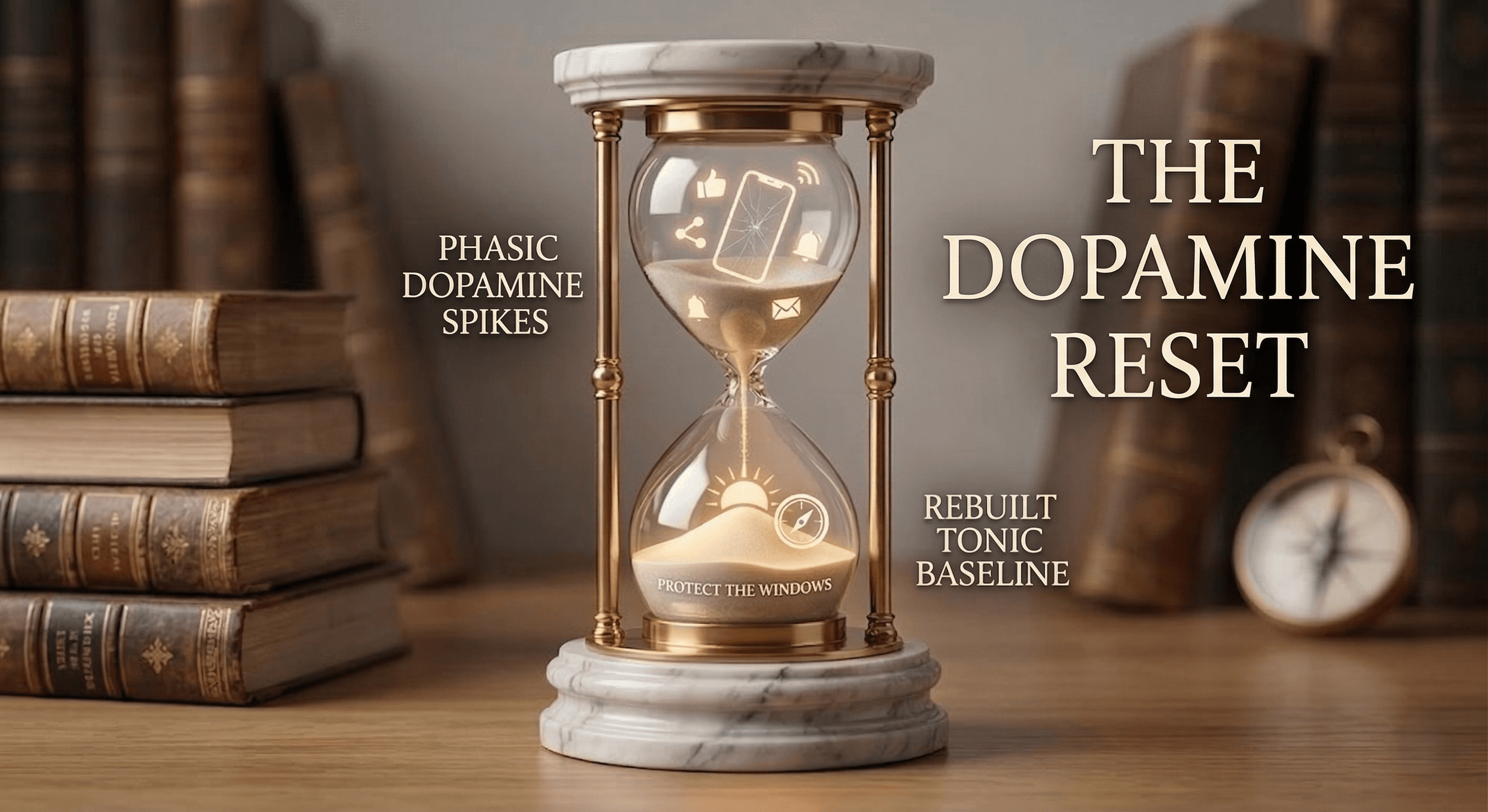
Tonic dopamine is your baseline. Your resting level of motivation, drive, and mood. It's the reason you wake up and feel either ready to go or completely flat. It's running in the background all day, every day.
Phasic dopamine is the spike. The burst you get from a notification, a like, a new message, a bite of sugar, a new video loading on your screen.
Here's where it gets dangerous.
Every phasic spike comes at a cost. Every time your brain gets a quick hit, your tonic baseline drops. The more spikes you chase, the lower your resting motivation falls.
Read that again. Because this is the mechanism behind everything you've been struggling with.
Why Everything Feels Harder Than It Should
Think about what your average morning looks like.
You wake up. Before your feet touch the floor, you check your phone. Notifications. Messages. A quick scroll. Maybe a video or two.
In the first 10 minutes of your day, you've given your brain 20, 30, maybe 50 phasic dopamine spikes. Each one tiny. Each one pulling your baseline lower.
By the time you sit down to do actual work, your brain is already in a deficit. The thing you need to focus on, the project, the workout, the business task, it requires effort. And effort, in a dopamine-depleted brain, feels like pain.
Not regular difficulty. Actual neurological resistance.
This is why you can watch 3 hours of motivational content and still not move. The content gave you phasic spikes. It felt like progress. But it actually lowered your baseline, making real work feel even harder by comparison.
You didn't lose your motivation. You spent it. Before you even started.
I explored this same mechanism in why you're actually stuck. Your brain isn't broken. It's responding to the inputs you're feeding it.
The Loop Most People Never Escape
Here's the part nobody talks about.
Your brain adapts. When you consistently flood it with cheap dopamine, the receptors start to numb. Huberman explains that this is the same mechanism behind every form of addiction: the baseline drops so low that you need more and more stimulation just to feel normal.
Not good. Just normal.
So you scroll more. You eat more sugar. You check your phone more. You open new tabs while working. You binge content that feels productive but produces nothing.
And the cruel part? The whole time, you're telling yourself you're lazy. That something is wrong with you. That everyone else seems to have it figured out and you're falling behind.
You're not falling behind. You're running on a brain that has been trained to crave junk and resist effort.
The people who seem to have it figured out? They're not more talented. They're not more disciplined. They're either running on a healthier dopamine baseline, or they've learned how to rebuild one.
The Dopamine Deficit Cycle
Let me map this out so you can see the full picture.
Stage 1: You wake up and immediately reach for your phone. Your brain gets flooded with micro-hits of dopamine from notifications, messages, social media. Feels normal. Feels like you're just "checking in."
Stage 2: Your tonic baseline drops. By 9 AM, your resting motivation is already depleted. The work you need to do now requires more effort than it objectively should because your brain has been pre-drained.
Stage 3: You sit down to work and feel resistance. Not the productive kind of challenge. The kind where your brain physically pulls you toward something easier. You open a new tab. Check your phone. Get a snack. Anything to escape the discomfort of effort.
Stage 4: You feel guilty. You tell yourself you need more discipline. You watch a motivational video. That video gives you another phasic spike, which drops your baseline even further. You feel inspired for 20 minutes, then crash harder.
Stage 5: By evening, your brain is so depleted that the only thing that feels good is the heaviest stimulation available. Junk food. Binge watching. Scrolling until your eyes burn. You go to sleep overstimulated and under-rested.
Stage 6: You wake up and repeat.
This isn't a willpower problem. This is a neurochemical cycle. And you cannot think your way out of a chemical imbalance.
Why Willpower Was Never the Answer
Research published in the Journal of Personality and Social Psychology by psychologist Roy Baumeister showed that willpower functions like a muscle. It fatigues with use. Every decision you make throughout the day, from what to eat for breakfast to whether to check Instagram, chips away at the finite reserve you have left for the choices that actually matter.
By evening, the tank is empty. And what surrounds you when the tank is empty is what you'll default to.
If your environment is full of screens, junk food, and isolation, that's exactly what you'll consume. Not because you're weak. Because your biology is doing exactly what 200,000 years of evolution designed it to do: follow the path of least resistance to the nearest dopamine source.
This is why I wrote the cage is the problem. The rats in Rat Park didn't have more discipline than the caged rats. They were the same species. The same biology. The same brain chemistry. They just had a better room.
The solution isn't fighting your biology. It's redesigning your environment so your biology works for you instead of against you. I broke down exactly how to do that in how I hacked my brain to stop being lazy.
The Phone Cutoff: One Move You Can Make Tonight
I'm not going to give you a 17 step system. I'm going to give you one move.
Tonight, at 9 PM, put your phone in another room.
Not on silent. Not flipped over. In another room, plugged into a charger, out of arm's reach.
Buy a $10 alarm clock if you need to. This one change eliminates the single biggest dopamine drain in your life: the scroll before sleep and the scroll when you wake up.
Those two windows, the last 30 minutes of your night and the first 30 minutes of your morning, are when your brain is most vulnerable. When you fill them with cheap hits, you set the baseline for the entire next day.
When you protect them, you give your tonic dopamine a chance to stabilize. You wake up with a brain that actually wants to do hard things.
One night. That's all I'm asking. Try it and feel the difference tomorrow morning.
But Here's What I Need to Be Honest About
That one move will help. But it's one move.
Your phone is not the only thing hijacking your dopamine. Your entire environment is designed to keep you overstimulated: the apps, the notifications, the food, the content, the people around you.
And here's the thing most people get wrong. They try to fix the problem without knowing where the problem actually is. They attack everything at once, burn out in 4 days, and conclude they're the problem.
They're not. They just skipped the diagnosis.
The Diagnosis Before the Treatment
I built a tool called The 15 Minute Brain Audit. It's a free self-assessment. 5 tests. 25 questions. It takes 15 minutes and tells you exactly where your brain is working against you and why your discipline keeps breaking down.
It scores you across five areas: your dopamine sensitivity, your prefrontal fatigue (willpower budget), your environment design, your identity alignment, and your system architecture.
At the end, you get a specific diagnosis. Not a vague "you need more discipline." A clear score that tells you whether you're dealing with low, moderate, high, or severe overstimulation, and what that means for you specifically.
Think of it as the X-ray before the treatment. You don't fix what you can't see.
Download The 15 Minute Brain Audit (Free) →
If Your Score Is Above 75
Here's what I know about you if you scored above 75 on the Brain Audit. You've been stuck in the cycle. Burst of motivation, a few good days, complete collapse. Over and over.
That pattern has a neurological explanation. And it has a neurological fix.
I built a 7 day protocol called The Dopamine Reset. It's the system that takes what the Brain Audit diagnosed and actually rewires it, day by day.
Day 1: The Dopamine Audit. See exactly how many hits your brain is getting without you realizing.
Day 2: How dopamine actually works (tonic vs. phasic, and why you've been losing).
Day 3: The Dopamine Menu. Swap low ROI habits for high ROI ones without going full monk mode.
Day 4: The 2 Minute Rewire. Why starting is everything and finishing is optional.
Day 5: Micro wins and momentum stacking. Build a wave that carries your entire day.
Day 6: Engineer your environment. Five physical changes that work 24/7 without willpower.
Day 7: Future proofing your focus. A reset ritual so one bad day never becomes a bad month.
The Brain Audit shows you where the damage is. The Dopamine Reset fixes it.
The Question I Want You to Sit With
Before you go, think about the last time you sat down to do something that mattered to you and couldn't start. Not because you didn't care. But because your brain just wouldn't cooperate.
What's the one thing your brain keeps resisting, even though you know it would change your life?
Name it. Because once you see the pattern, you can't unsee it. And once you understand that it's not a character flaw but a neurochemical cycle, you stop blaming yourself and start fixing the system.
Take the Brain Audit tonight. See your score. Then use The Dopamine Reset to fix what it finds.
Your brain isn't broken. It's just been running the wrong program. Time to rewrite it.