
I Hacked My Brain to Stop Being Lazy
Laziness isn't a personality trait. It's a signal that your system is broken. Here's exactly how I rewired my brain for execution.
If you've ever struggled with procrastination, if you've ever felt like you're stuck in a loop of wanting to do more but never actually doing it, this is for you. I spent years calling myself lazy. Turns out, I wasn't lazy. My system was broken. And once I fixed the system, "laziness" disappeared almost overnight.
I'm going to show you exactly how I hacked my brain to stop being lazy, not through willpower, motivation, or discipline, but through understanding how your brain actually works and using that knowledge to your advantage.
Why You Feel Lazy (It's Not What You Think)
Laziness isn't a character flaw. It's your brain's default setting. Your brain is designed to do three things: conserve energy, avoid pain, and seek instant gratification. These impulses kept our ancestors alive. But in the modern world, they keep you on the couch.
Every time you choose Netflix over your goals, your brain is doing exactly what evolution designed it to do: choosing the path of least resistance, conserving energy for a threat that no longer exists. The problem isn't you. The problem is that you're fighting 200,000 years of evolutionary programming with willpower. And willpower always loses.
Research shows that willpower is a finite resource that depletes throughout the day, similar to a muscle that fatigues with use. This means every decision you make (from what to eat for breakfast to whether to check Instagram) chips away at the willpower you need for important tasks. By the time you sit down to work on your goals, the tank is already empty.
Brain Hack #1: Remove the Need for Motivation
Motivation is the biggest lie in personal development. It's portrayed as this magical force that, once found, carries you to success. In reality, motivation is an emotion, and like all emotions, it's temporary, unreliable, and based on how you feel in the moment.
The hack: stop waiting to feel motivated and start designing your environment. Want to work out? Sleep in your gym clothes with your bag packed by the door. Want to eat clean? Don't keep junk food in the house. Want to write? Block distracting websites and put your writing app in fullscreen. Want to stop scrolling? Put your phone in another room.
Every barrier you add between yourself and a bad habit makes it harder. Every barrier you remove between yourself and a good habit makes it easier. When the right action is the easiest action, you don't need motivation. You just do it because it's the path of least resistance, and that's exactly what your brain wants.
Brain Hack #2: The 2-Minute Start Method
The hardest part of any task isn't the work itself. It's starting. Your brain resists starting because it imagines the entire effort ahead: the full workout, the complete project, the 2-hour study session. That mental picture of effort triggers an avoidance response before you've even begun.
The hack: don't commit to the full task. Commit to 2 minutes. Just 2 minutes. Open the laptop and write one sentence. Put on your gym shoes and do one set. Open the textbook and read one page. That's it.
Here's the science: once you start, a phenomenon called "task inertia" kicks in. Newton's first law of motion applies to your brain too: an object in motion stays in motion. In almost every case, those 2 minutes turn into 20, which turn into an hour. You trick your brain past the activation energy, and momentum handles the rest. I've used this technique every single day for years, and it's never failed me.
Brain Hack #3: Reward the Process, Not the Outcome
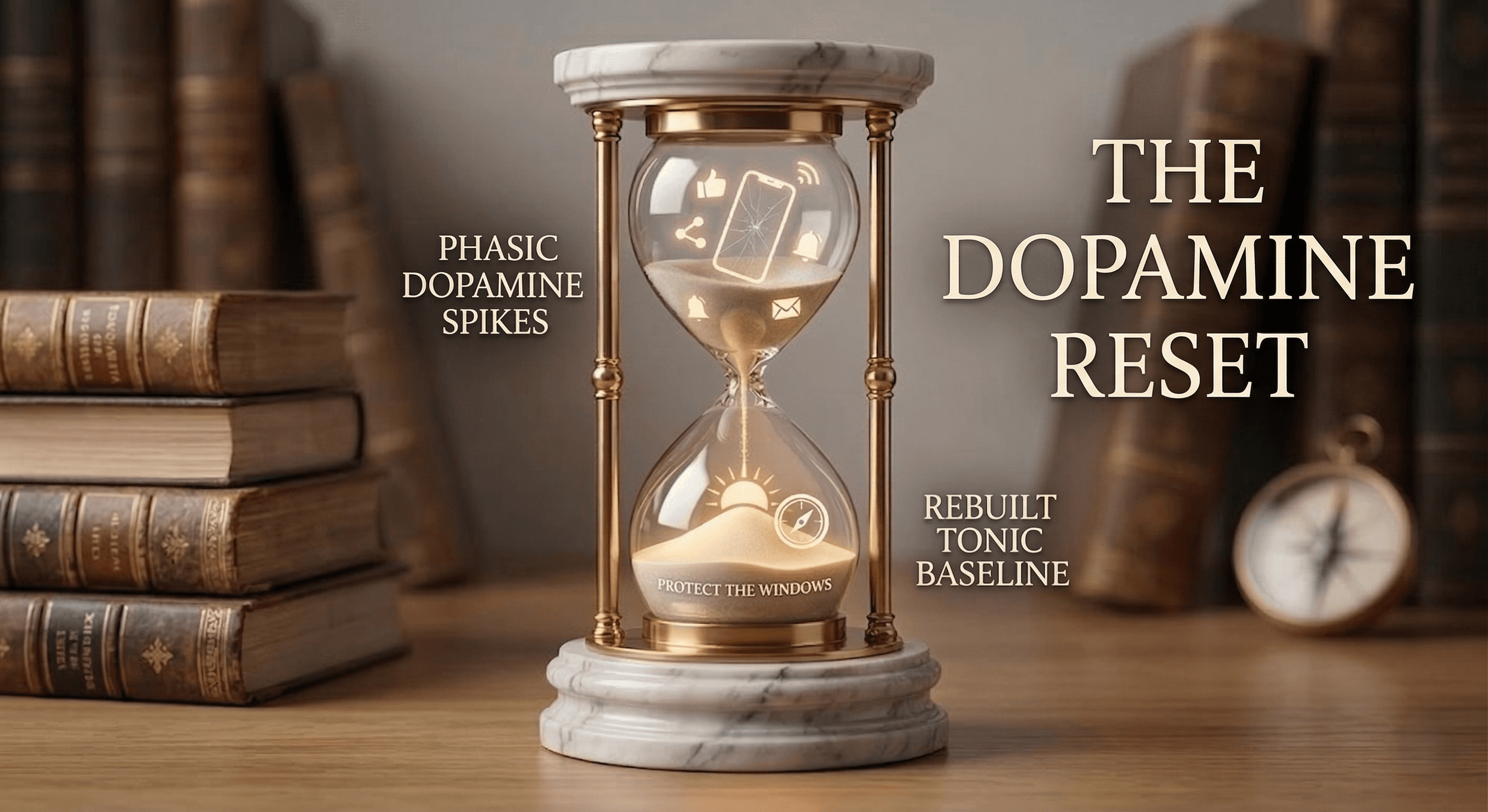
Your brain needs dopamine to stay engaged in any activity. The problem with long-term goals is that the dopamine reward (the result) is weeks, months, or years away. Your brain can't wait that long. It wants dopamine now, which is why scrolling social media and eating junk food are so addictive. They deliver instant dopamine hits.
The hack: create dopamine rewards for the process, not just the outcome. Finished your morning workout? Celebrate it: literally say "let's go" out loud, pump your fist, check it off a list with a satisfying pen stroke. Completed your deep work block? Reward yourself with 15 minutes of something you enjoy. Stuck to your meal plan all day? Acknowledge the win before you go to bed.
These micro-rewards rewire your brain's dopamine pathway to associate action with pleasure instead of associating avoidance with comfort. Over time, your brain starts craving the productive behaviors because they've been paired with positive reinforcement. This is the same mechanism that makes video games so addictive. You're just applying it to your real life.
Brain Hack #4: Eliminate Decision Fatigue
The more decisions you make throughout the day, the worse each subsequent decision becomes. This is why Steve Jobs wore the same outfit every day and why Mark Zuckerberg eats the same breakfast. They weren't being eccentric. They were conserving mental energy for decisions that actually matter.
The hack: automate as many daily decisions as possible. Plan your meals for the week on Sunday. Lay out your clothes the night before. Create a morning routine that's identical every day. Schedule your workouts at the same time. When these decisions are pre-made, your brain has more bandwidth for creative work, problem-solving, and execution.
Brain Hack #5: Use "Implementation Intentions"
Research by psychologist Peter Gollwitzer found that people who create "implementation intentions" (specific if-then plans) are significantly more likely to follow through on their goals. Instead of "I'll work out this week," you commit to: "When my alarm goes off at 6 AM on Monday, Wednesday, and Friday, I will immediately put on my gym shoes and drive to the gym."
The specificity eliminates ambiguity, and ambiguity is where procrastination lives. When you know exactly what you're going to do, when you're going to do it, and where you're going to do it, there's no room for your brain to negotiate or delay.
The 30-Day Rewiring Protocol
Here's how to put all five hacks together into a system:
Week 1: Redesign your environment. Remove friction from good habits, add friction to bad ones. Put your phone in another room during work hours.
Week 2: Implement the 2-minute start for every task. Don't think about it. Just start for 2 minutes.
Week 3: Add micro-rewards after every completed task. Build the dopamine association with action.
Week 4: Automate your decisions. Create a default schedule that runs on autopilot.
After 30 days of this protocol, laziness becomes almost impossible. Not because you suddenly developed superhuman discipline, but because your brain has been rewired. The default is now action, not avoidance. The path of least resistance now leads to your goals, not away from them. That's when everything changes.