
The Skill That Separates $3K Months From $10K Months
It's not knowledge, connections, or luck. After twelve years of failing, I discovered that the real gap between people who win and people who stay stuck comes down to one trainable skill: taste.
Let me tell you something nobody told me when I was driving Uber in Los Angeles, scraping together enough to cover rent.
I thought the gap between me and the people winning was knowledge. Then I thought it was connections. Then I thought it was luck.
Twelve years of failing taught me it was none of those things.
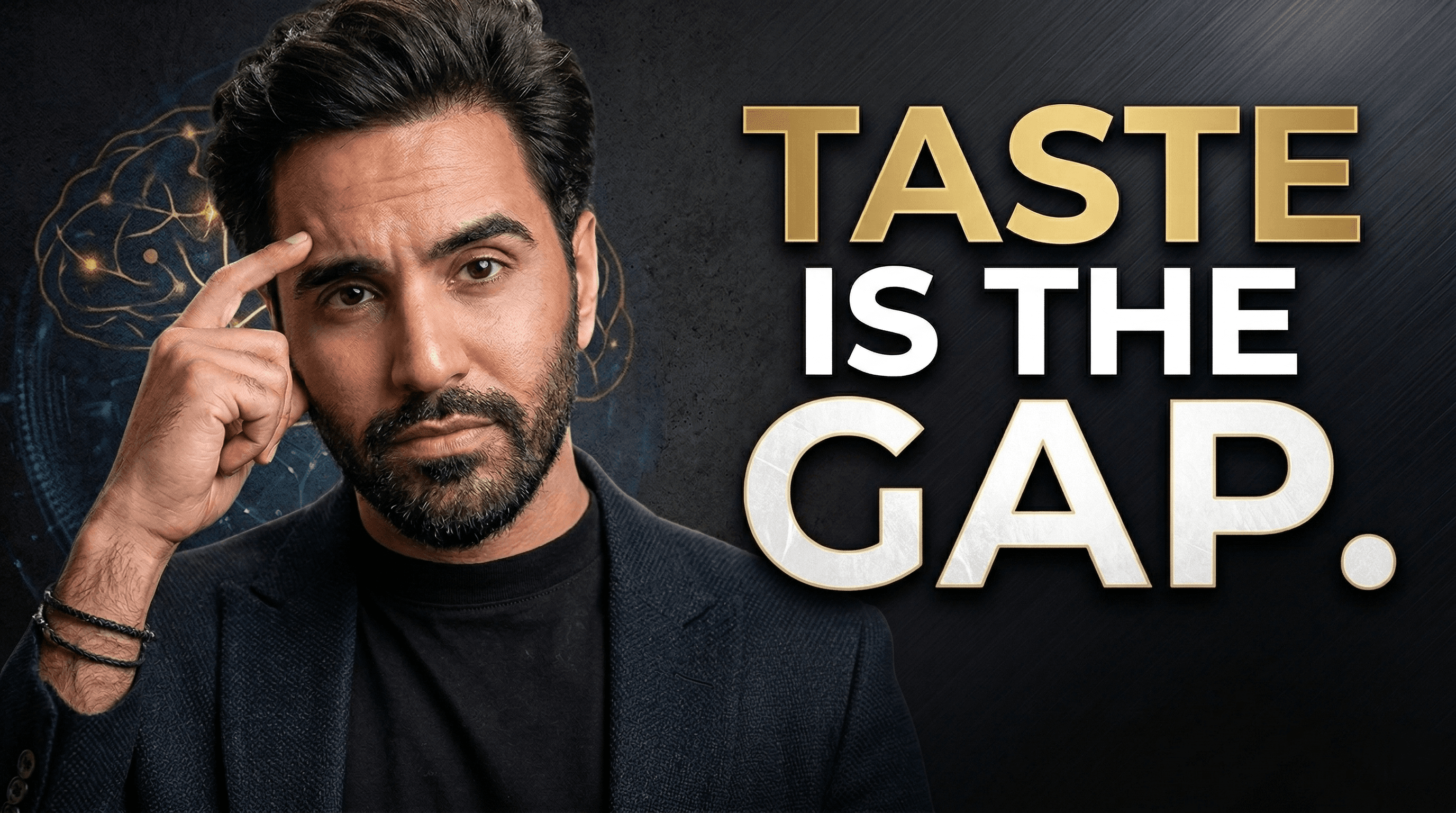
The real gap? Taste.
Not "fashion taste" or "good music taste." I'm talking about the ability to look at two options and instinctively know which one is worth your time, your money, your life.
The ability to walk into a room and know whether the people in it will elevate you or drain you. To look at a business idea and feel whether it has weight or whether it's just noise. To read a piece of content and know in three seconds if it was made by someone who cares or someone who's copying.
That skill changed everything for me. And the wild part? Science actually backs this up.
The Neuroscience of Taste
Researchers at the University of Iowa ran a famous study called the Iowa Gambling Task (Bechara et al., 1997, published in Science). They gave participants four decks of cards. Two decks were rigged to lose money over time. Two were rigged to win.
Here's what happened: participants started generating stress responses to the bad decks before they consciously knew which decks were bad. Their bodies knew. Their intuition fired before their logic caught up.
The study proved something powerful. Good decision making isn't just analytical. It's pattern recognition built through experience. Your brain literally learns to feel the difference between what works and what doesn't.
That's taste. And it's trainable.
Your brain stores every experience, every input, every outcome you've ever observed. Over time, it builds a massive unconscious database that generates "gut feelings" about new situations. Those gut feelings aren't mystical. They're your neural networks doing rapid pattern matching against millions of stored data points.
The quality of those gut feelings depends entirely on the quality of the data your brain has been trained on. Feed it garbage inputs, and it produces garbage instincts. Feed it excellence, and it starts recognizing excellence automatically.
Why Most People Stay Stuck
Most people at $3K a month aren't lazy. They're not stupid. They're surrounded by bad inputs.
Bad content. Bad advice. Bad environments. Their pattern recognition is being trained on the wrong data set.
Think about it like this. If you spend every day consuming mediocre content, following mediocre creators, and sitting in mediocre rooms, your brain calibrates "normal" to that level. Your taste adjusts downward. You literally lose the ability to distinguish premium from average because average is all you know.
This is the same mechanism I wrote about in the cage is the problem. Your environment doesn't just influence your behavior. It trains your nervous system. It calibrates your perception of what's possible, what's normal, and what's excellent.
Dr. K. Anders Ericsson's research on expert performance (the same research that inspired the "10,000 hour rule") showed that elite performers don't just practice more. They practice with better feedback loops. They surround themselves with higher standards. Their environment teaches their nervous system what excellence looks and feels like.
A chess master doesn't calculate every possible move. After thousands of high-quality games, their brain recognizes patterns instantly. They "feel" the right move. That feeling is trained taste. A master chef doesn't measure every ingredient. After years in excellent kitchens, they know when something is right by how it smells, how it looks, how it feels. That knowing is trained taste.
And the exact same principle applies to business, content, relationships, and life decisions.
This is why environment is the first pillar of everything I teach. Not mindset. Not motivation. Environment. Because environment trains taste. And taste drives every decision you make.
How I Trained Mine
When I was failing for twelve years, my environment was chaos. The inputs were wrong. The people around me meant well but they couldn't show me what I hadn't seen.
The shift started when I began studying premium brands. Not just what they sold, but how they made you feel. I noticed the gap between content that moved people and content that just filled feeds. I started cutting everything that didn't meet a standard I couldn't even articulate yet. I just knew it wasn't right.
That "knowing" is taste. And it compounds.
Once I could see the difference between good and great, I couldn't unsee it. My content got sharper. My decisions got cleaner. My circle got smaller but infinitely more powerful.
The $10K jump didn't come from a new strategy. It came from a new standard.
I see this pattern everywhere now. The creators who break through aren't the ones who post the most. They're the ones whose taste forces them to only publish work that meets a certain bar. The entrepreneurs who build real businesses aren't the ones who chase every trend. They're the ones whose taste tells them which opportunities have weight and which ones are noise.
The gap between $3K months and $30K months isn't information. Everyone has access to the same information. The gap is the ability to look at that information and know which 5% actually matters.
The Three Laws of Taste
After years of building this, I've distilled it into three principles.
Law 1: Taste Is an Input Problem, Not an Output Problem
You can't create at a level you've never consumed. Want to write better? Read better. Want to build a premium brand? Study premium brands. Want to make elite decisions? Sit in elite rooms. Garbage in, garbage out applies to your entire life.
This is why I'm obsessive about what I consume. I don't scroll randomly. I study specifically. When I watch a video that moves me, I don't just enjoy it. I break down why it worked. When I see a brand that feels premium, I reverse-engineer the details that create that feeling. When I meet someone who operates at a level above mine, I pay attention to what they notice that I don't.
Every input is either upgrading your taste or degrading it. There is no neutral consumption. The content you consume, the people you follow, the rooms you sit in, they're all programming your pattern recognition whether you realize it or not.
Law 2: Taste Requires Subtraction, Not Addition
Most people think growth means adding more. More tools. More tactics. More content. More features. Taste is the opposite. It's knowing what to remove.
The best brands, the best creators, the best lives are defined by what they said no to. Apple didn't win by adding features. They won by removing everything that wasn't essential. The best writing isn't the longest. It's the most distilled. The best business strategy isn't the most complex. It's the most focused.
I apply this to everything now. When I'm creating content, I ask "what can I remove?" before I ask "what can I add?" When I'm evaluating an opportunity, I ask "what would I have to say no to?" before I ask "what could I gain?" The discipline of subtraction is where taste lives. As I wrote in 6 habits that changed my life, elimination creates more space than addition ever could.
Law 3: Taste Is Courage with Clarity
Knowing what's good means nothing if you don't have the nerve to hold the standard. Taste without execution is just opinion. The people who win are the ones who see the standard AND refuse to ship below it. Even when it's slower. Even when it costs more. Even when nobody else notices the difference.
This is the hardest law because the pressure to compromise is constant. "Just post something." "It doesn't have to be perfect." "Nobody will notice." And sometimes those voices are right. But there's a difference between perfectionism (which is fear disguised as standards) and genuine taste (which is knowing when something isn't ready yet).
The difference? Perfectionism paralyzes you. Taste propels you. Perfectionism says "it's never good enough." Taste says "this specific thing isn't right yet, and I know exactly what needs to change." One is vague anxiety. The other is precise judgment.
How to Upgrade Your Taste in 30 Days
Here's a practical protocol you can start this week.
Week 1: Audit Your Inputs
Write down everything you consumed in the last 7 days. Every piece of content. Every conversation. Every environment you spent time in. Now sort them into two categories: "Upgraded my standards" or "Degraded my standards." Be ruthless. If something was just entertainment that didn't teach you anything or challenge your thinking, it goes in the degraded column.
Most people discover that 80% or more of their inputs are either neutral or degrading. That's the calibration problem. You're training your pattern recognition on the wrong data set.
Week 2: Curate Ruthlessly
Unfollow every account that doesn't make you think, create, or grow. Replace them with the best in whatever field you're building in. Subscribe to three newsletters written by people operating at a level above yours. Buy one book that's considered the best in your industry and read it with a pen in your hand.
Week 3: Study Excellence
Pick one brand, creator, or business you admire. Spend a full week studying how they operate. Not what they do, but how they do it. What details do they pay attention to that others skip? What do they say no to? What standard can you feel in their work even if you can't articulate it?
This is the exercise that upgraded my taste faster than anything else. When you study excellence with intention, your brain starts absorbing the patterns automatically. You begin to "feel" quality before you can explain it.
Week 4: Apply the Standard
Take one thing you're working on (content, a project, a business decision) and apply your upgraded standard to it. Ask: "Would this impress me if someone else made it?" If the answer is no, don't ship it. Improve it until the answer is yes. That gap between your current output and the new standard you can now see? That's where all the growth happens.
The Real Reason This Matters
Here's what I want you to sit with.
Every decision you've made in the last 90 days was filtered through your current level of taste. The content you posted. The opportunities you chased. The people you gave your time to. The products you bought. All of it was shaped by your ability to distinguish signal from noise.
If you're not where you want to be, the fastest path forward isn't a new funnel or a new morning routine. It's upgrading the inputs that train your pattern recognition.
New environment. New standards. New room.
That's the invisible skill. And once you have it, everything else clicks faster than you thought possible.
Stop trying to do more with bad taste. Upgrade the taste and the doing takes care of itself.